Go Deeper with Certificate Programs
Human-Centered Systems Thinking is part of a certificate program:
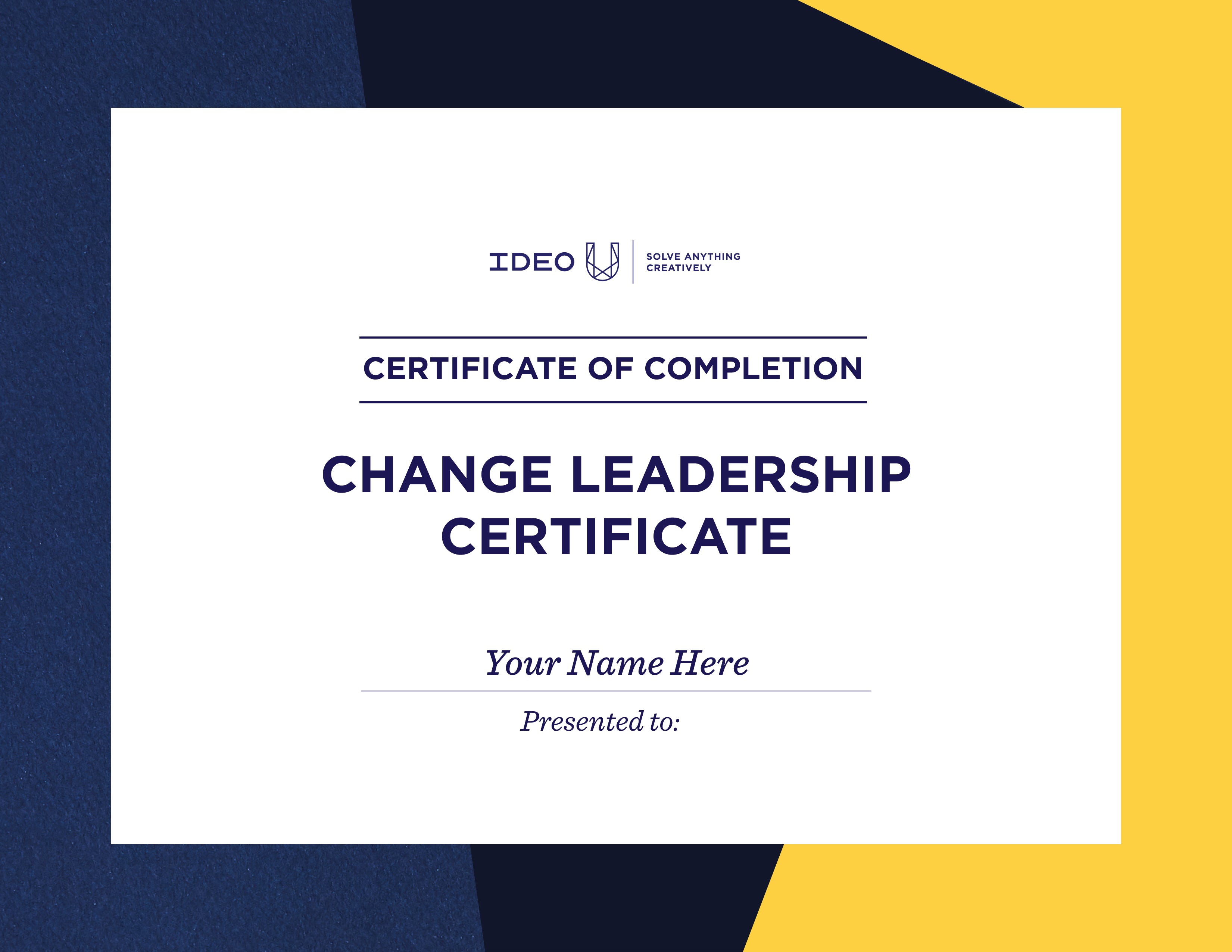
What You'll Get
 Week 1: Overview
 Week 1: Overview
Watch a sneak peek
-
 Human-Centered Systems Thinking – A sneak peek of the course

1 Video Lesson
-
Zooming In and Out - Bringing a human-centered lens to systems thinking.
1 Assignment
-
Define Your Systems Challenge: Choose a systems challenge from your work to help you practice and apply the mindsets and methods outlined in this course. Define your challenge in the form of a question. If you do not have a systems challenge at work, you can choose one as a model.
1 Discussion:
-
If you're familiar with systems thinking, what are some ways that you bring this mindset to your work? If you're not, how might your work benefit from a systems view?
 Week 2: Visualize the System
 Week 2: Visualize the System
3 Video Lessons
-
Uncover the Connections - Make sense of the relationships and interactions
between stakeholders. -
Make it Visible - Break down a complicated process
-
Go Beneath the Surface - Focus on solving the root causes of a problem
1 Assignment
-
Create a Systems Map: Choose one type of systems map based on your systems challenge and create the first iteration of it to share with your peers. Reflect on what you learned from the process.
3 Discussions
-
What are some other types of maps and tools you use to make sense of complexity?
-
What strategies do you use to align different perspectives and build a shared understanding?
-
Have you noticed any patterns of behavior in your own work? What might be the underlying structures or mindsets that contribute to these behaviors?
2 Resources
-
Three Ways to Map a System: Get guidance on how to choose the best map for your systems challenge.
-
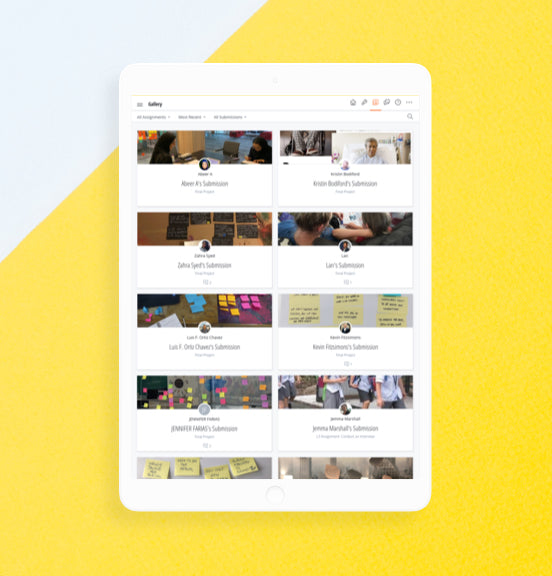
Systems Map Gallery: Get inspired by examples of how others have visualized their systems.
 Week 3: Humanize the System
 Week 3: Humanize the System
3 Video Lessons
-
Listen to the System - Uncover the needs, challenges, and motivations of the people in
your system -
The Power of Perspective - Unlock new ways of seeing and thinking
-
Look for Leverage - Look beyond the obvious solution
1 Assignment
-
Conduct a Stakeholder Interview: Choose one stakeholder from your systems map and conduct an in-depth interview. Then reframe your systems challenge and identify an opportunity for redesign.
3 Discussions
-
Think about the last system you interacted with. What was your experience and how did it influence your perspective?
-
What are techniques you like to use to help you get a new perspective on a challenging problem or situation?
-
Think back to a situation where a small shift, either in your personal or professional life, had an outsized impact. What was the change and how did it affect you and/or others?
 Week 4: Redesign the System
 Week 4: Redesign the System
4 Video Lessons
-
Activate the Levers of Design - Redesign systems in small but effective ways
-
Prioritize for Impact - Evaluate the impact and feasibility of different solutions
-
Experiment with the System - Test your ideas and deepen your understanding of your system
-
Surface your Learnings - Draw out insights from your prototype
1 Assignment
-
Test Solutions: Pick 1-2 ideas around each design lever and then choose 1 that is potentially high impact and easy to implement. Build a small prototype, test it out, and reflect on the outcome.
4 Discussions
-
Prototyping helps us explore how a system works, feels, responds to change. Of the three, which resonates the most with you, and why?
-
Which levers do you have the most control over in your organization? Which have you used to create positive change and improve outcomes?
-
Think about a time when you or others made a decision or implemented an idea that had unintended consequences. What was the outcome?
-
What is one small experiment you could try today that would be meaningful to learn from?
2 Resources
-
Prototyping Primer: Get familiar with the process of prototyping.
-
Prototyping Gallery: Get inspired by examples of how others have approached prototyping.
 Week 5: Looking Ahead
 Week 5: Looking Ahead
1 Video Lesson
-
Systems Change by Design - Expanding your sphere of influence.
1 Assignment
-
Envision the Future: Imagine that you learned from your experiment, and kept iterating and experimenting over a period of time. Write a story from the future about how you were able to shift the system toward a better outcome.
1 Discussion
-
After learning about the mindsets and methods of human-centered systems thinking, are there any big complex challenges that you feel inspired to take on?
Meet Your Instructor

Deirdre Cerminaro
Former Executive Design Director, IDEO
Deirdre was an Executive Design Director and co-lead of the Systems & Strategy practice at IDEO. As a former architectural designer with a background in business and psychology, she has a knack for breaking down complex systems and finding simple levers to drive lasting change. She is passionate about bringing a human-centered lens to intractable systemic challenges, especially in education where much of her work had focused at IDEO.

Deirdre Cerminaro
Former Executive Design Director, IDEO
Deirdre was an Executive Design Director and co-lead of the Systems & Strategy practice at IDEO. As a former architectural designer with a background in business and psychology, she has a knack for breaking down complex systems and finding simple levers to drive lasting change. Passionate about the power of systems design to create a more equitable future, much of her work at IDEO had focused on designing education systems—from reimagining student services at a community college in Ohio to creating programs to deliver quality, affordable education at scale in Peru.
Deirdre holds a B.A. in Cognitive Science from Yale University and an MBA from the Yale School of Management. In her spare time, she can usually be found outside with her dog or off on an adventure. She's ridden her bicycle across the U.S. twice and hiked the 211-mile John Muir Trail.
FAQs
We offer three types of courses: self-paced courses, cohort courses, and certificate programs. Cohort courses run on a set calendar, with fixed start and end dates. Course learning is self-paced within those dates and requires approximately 4-5 hours per week over 5 weeks. Courses consist of videos, activities, assignments, access to course teaching teams, and feedback from a global community of learners. There are also optional 1-hour video Community Conversations, held weekly by the teaching team.
All of our cohort courses are fully online, so you can take them from any time zone, anywhere in the world. With our cohort course experience, while you'll be learning alongside other learners, you'll still have the flexibility to work at the pace that fits your own schedule. There aren't mandatory live components, so you don't have to worry about having to log in at a specific time. At the same time, you'll have access to a teaching team who will answer your questions and give feedback on your assignments throughout the course.
Cohort courses run on a set calendar with fixed start and end dates. You will be learning alongside other learners, but still have the flexibility to work at a pace that fits your own schedule—there aren't mandatory live components. In cohort courses, you'll have access to a teaching team who will answer your questions and give feedback on your assignments throughout the course. Self-paced courses allow you to start, learn, and finish a course completely on your own schedule. Since courses are on-demand, there's no community experience of going through the material with other learners. In on-demand courses, there is no teaching team providing feedback on your submissions.
Upon completing a course, the certificate and digital badge for the course will automatically become available to you on your profile page within 24 hours. There, you can view your certificate, download it, and access your Credly badge. We've partnered with Credly, a leading digital credentialing platform, to provide learners with a digital badge that they can share on social media, email signatures, or add to their LinkedIn profiles or resumes.
IDEO U courses are not currently eligible for university credit.
You'll need a stable internet connection and a device (computer, tablet, or phone) with a modern web browser such as Chrome, Firefox, Safari, or Edge. Some course activities may work better on a computer than a mobile device. You'll also need to be able to view videos, which requires a browser that supports HTML5 video.
Once you enroll in a course, you can access it by logging into your IDEO U account at ideou.com and clicking on your profile icon in the upper right corner. Then click on "My Courses" to see all of your enrolled courses. Click on the course you want to access to go to the course page. Your courses are always available in your account, even after the course end date.
We offer a 10-day satisfaction guarantee for our cohort courses (starting from the course start date). If you're unhappy with the course for any reason, reach out to us within 10 days of the course start date and we'll give you a full refund. To process a refund, contact us.
Yes, we do! We offer group pricing when you purchase 5 or more seats for the same course. Contact us at learner-success@ideou.com to get a quote.
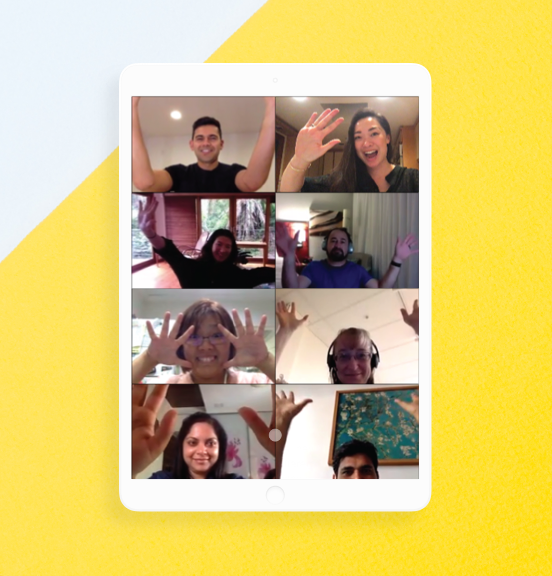
Collaborate with a Global Community
Work with Expert Coaches
Our teaching team has extensive applied industry knowledge. They'll help deepen your understanding and application of the course content by facilitating written discussions, live video moments, and assignment feedback.
Expand Your Network
Join virtual live discussion groups for deeper conversation, reflection, and connection led by teaching team members and available multiple times a week across time zones.
Receive Feedback
Gain tips, techniques, and a downloadable feedback guide; and share and receive feedback on assignments from peers.

Loved by Learners Across the Globe


Human-Centered Systems Thinking
“For me, the most exciting application of human-centered design is when it is aimed at reimagining the complex systems of our society—like education or healthcare—that are full of promise but also fraught with inequalities. This is also the space where systems design is needed the most.”
Human-Centered Systems Thinking
“I've never met a designer who is able to fuse the crafts of systems thinking and human-centered design more effectively. Deirdre effortlessly sensemakes complex systems. And perhaps most importantly, she's a teacher and a leader who is a master at enabling others to embrace the skills and mindsets of systems design”
Human-Centered Systems Thinking
“Public education, decentralized finance, the energy ecosystem—these are examples of systems too complex and distributed to shift through a top-down solution. Deirdre is a dynamic systems designer who shares her knack for simplifying the complex and uncovering human-centered opportunities for change.”
Human-Centered Systems Thinking
“Deirdre is both process driven and intuitively insightful when it comes to systems design. She has helped us design complex systems at the service of reimagining a better learning systems for all Peruvians... she just rocks!”
Learners Also Purchased
-
 Part of Certificate Program
![Designing for Change]()

Designing for Change
Start small, start with people, start nowCohort Course 5 Weeks- Regular price
- $899
- Sale price
- $899
- Unit price
- per
-
![Leading Complex Projects]()

Leading Complex Projects
An adaptable approach to deliver stronger outcomes in changing conditionsCohort Course 5 Weeks- Regular price
- $899
- Sale price
- $899
- Unit price
- per
-
![Human-Centered Service Design]()

Human-Centered Service Design
Design the moments that matterCohort Course 5 Weeks- Regular price
- $899
- Sale price
- $899
- Unit price
- per



Enroll As a Team
The practice and application of design thinking, innovation, and creativity is highly collaborative and team based—which is why we believe that learning is better together. Take a course as a team and develop new skills and mindsets, have deeper discussion during course kickoff and debrief sessions, and build a shared understanding.